


Samvada In Clay
Artistic Expression


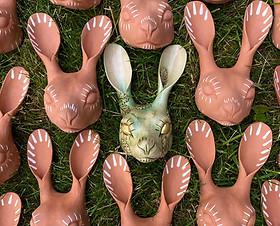


The exhibition Samvāda (conversation) with Clay – the Indo-British Ceramics residency & exhibition opened at Artcore Gallery in July 2025. This exciting new exhibition brought together acclaimed Indian ceramic artist Vinod Daroz and Derby-based artist Abbie Sunter for a month-long exploration of material, memory, and place through clay. From 20th June to 17th July 2025, the artists worked at The University of Derby's ceramics department to create works for this collaborative exhibition, fostering a cross-cultural dialogue through shared processes and practices.
Alignments
The University of Derby's MA Arts (Fine Art & Photography) Degree Show, 2024.
(www.instagram.com/maarts_derbyuni)
On Friday, 20th September, the MA Arts Degree Show was formally opened at Artcore Gallery, on Albert Street in the city centre of Derby.
The 2024 exhibition featured work from six students. Armstrong Oke Agoreyo, Abbie Sunter, Amy Vallance, Lucy Swinhoe, Layla Swinhoe and PhD student Jeannene F. Howe.
Abbie's installation work 'The Garden of England' won two awards, The QUAD Residency Award and Artcore's Emerging Artist Award, a £1,500 bursary and exhibition opportunity.

I'm incredibly excited to share this work with you, it is the culmination of two years of experimentation, progression and searching. I undertook this MA to push my practice further and to create work that was larger in scale and concepts.
Those who know me, know that I will often aim big without really considering the consequences of what that means but that I will always power through with phrases like "it'll be reyt" and "I'll have a breakdown once it's finished". Although there have been times on this journey where I wished I made things easy for myself, the pay off now is that I get to present you with a tactile and real-life version of the worlds that I imagine so clearly in my mind. I hope you enjoy seeing it as much as I enjoyed making it.


How It's Made
I often get asked how I've made something and I forget that not everyone has seen me move through this process of making over the last 8 months or has even had the chance to work with these materials and processes.
So below, if you'd like to know more, is a short description of the techniques and processes behind the work.

Standing Stones & Wall Stones
Each standing stone was created using a technique called 'coiling', a process by which coils are layered upon one another from bottom to top, being pushed together and blended as you go. Each stone would take between 4 - 6 days depending on size. By coiling the forms I could control the shapes & sizes of each stone, building up layers and allowing them time to dry before continuing to add more layers and therefore, height. Each piece has been fired twice and finished with real gold leaf.
The "Wall Stones" are also ceramic. the illustrations were digitally drawn and used to create silkscreen. These designs were then screen printed directly onto the clay using a mixture of Red Iron Oxide and Yoghurt. the yoghurt acted as a suspender for the oxide particles which allowed them to be pulled through the screen evenly. Once dry, the wall stones were fired, this process burns away the natural material of the yoghurt but binds the iron oxide to the surface of the clay, resulting in beautifully clean illustrative print.
You can see more of this making process by visiting my Instagram account below.


Stag in the Green
The piece has been a labour of love since I am not accustomed to working with textiles. However, the body of the stag was created using a plywood frame, similar to a 3D-jigsaw puzzle which was cut out on a CNC-machine.
The body was then filled out using a combination of wire framing, sponge and expanding foam that was shaped to create the right curves of the body.
The patchwork quilt was made by sourcing second hand fabrics, all of which were cut and sewn together using a sewing machine to create rough pattern sections for the legs, body and neck. These were then hand-stitched onto the form of the stag to create his patchwork body.
The head of the stag is ceramic and was sculpted by hand using a variety of hand-building techniques. It was then bisque fired and glaze fired and finished with a spray lacquer to enhance the colour and durability.
The antlers were also handmade with wire. sponge and 'foam clay'. They were then sculpted and painted, and finished with gold leaf.
You can see more of this making process by visiting my Instagram account below.

The Guardians
Each of the 'Guardians', the Owl, Magpie and Raven that sit atop the stones and guard the entrance to The Otherworld, are handmade ceramic sculptures.
Each one was individually sculpted, fired and glazed and finished with gold leaf.
The sculpting of these pieces was the most familiar part of the whole making process when it comes to this installation.
Sculpting with clay has always been something that I find equal parts challenging and exciting. during this project I have worked with clay in new ways and pushed the limit of my technical ability. But if there's one thing that clay teaches you, it's that practice makes progress, not perfection.
if you'd like to see more examples of my sculpting process, you can find videos by visiting my Instagram account below.